Visuals
The annexation area
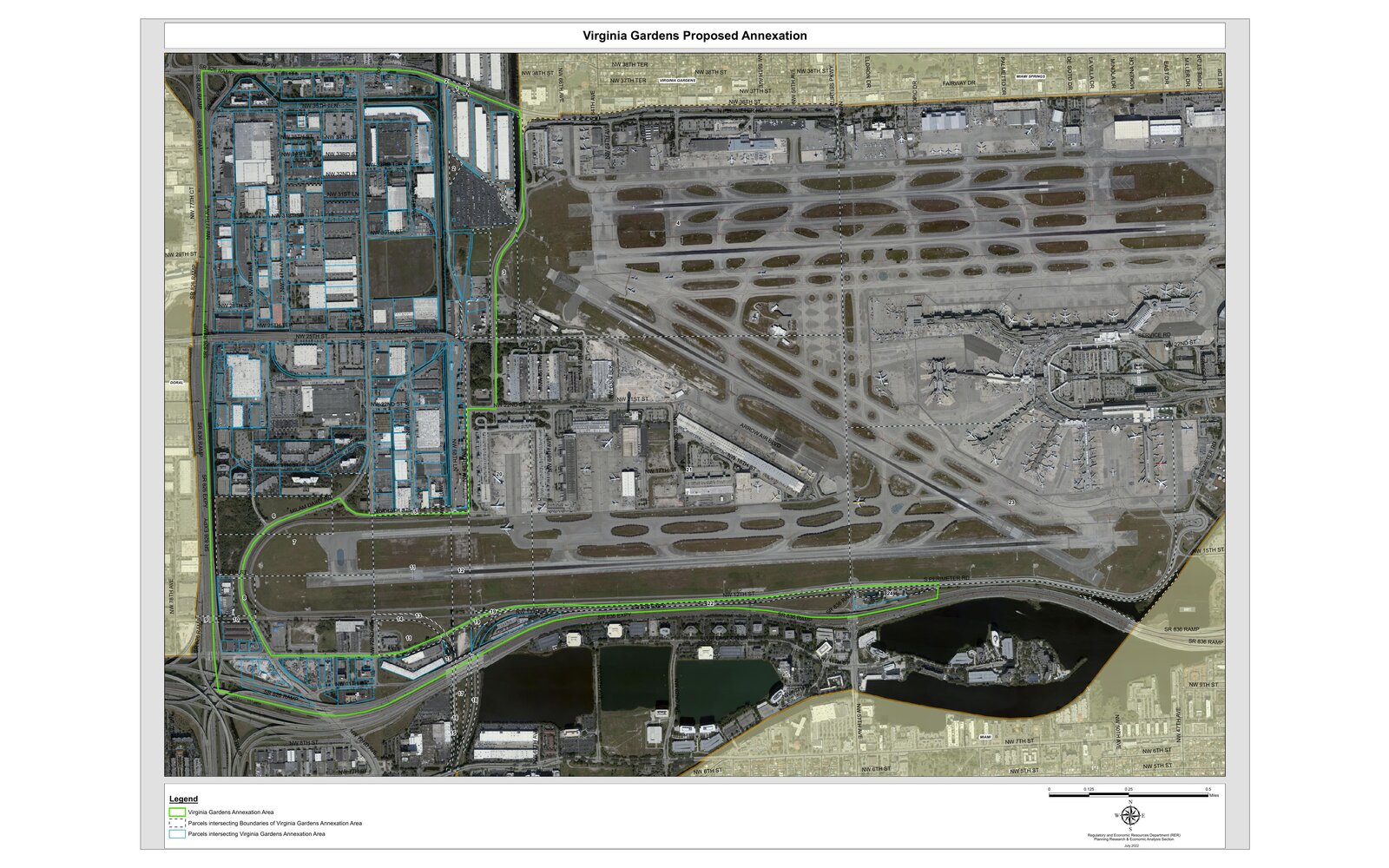
A fiscal and economic feasibility study of annexing a 1.6-square-mile industrial employment center beside Miami International Airport — quantifying the tax base, revenues, and service costs behind the Village's expansion.
The Village of Virginia Gardens is a fully built-out, single-family enclave of roughly 2,364 residents wedged against Miami International Airport and the 836/Palmetto Expressway. With almost no vacant land inside its borders, the Village has long sought to annex approximately 1.6 square miles of contiguous, commercially and industrially developed land to its southwest — an employment center with no residential population of its own.
BusinessFlare® was engaged to update the Village's 2017 annexation application to Miami-Dade County with fresh data. The analysis refreshed population, land-use, and tax-base figures; inventoried the services the Village would assume; and modeled the revenues the annexation would generate against the cost of delivering those services — the fiscal case at the heart of the County's approval process.
The annexation area carries a 2021 taxable value of roughly $1.06 billion — including about $73.9 million in tangible personal property — against a Village whose entire existing taxable value is about $210 million. At the Village's 4.9-mill rate, the area would generate roughly $5.17 million in new annual ad valorem revenue, comfortably exceeding the estimated $1.58M-$2.27M cost of enhanced services and the County's reported $1.52M cost of serving the area. The math confirmed that annexation is fiscally self-sustaining and strengthens the Village's tax base.
How BusinessFlare® built the fiscal case for annexing an airport-adjacent industrial district.
Virginia Gardens is essentially landlocked — a residential enclave with commercial frontage only along NW 57th Avenue and NW 36th Street. To grow its tax base, improve local governance over nearby development, and capture the economic activity on its doorstep, the Village proposed annexing about 1.6 square miles (1,026 acres) of contiguous land to its southwest.
Using Miami-Dade Property Appraiser data, BusinessFlare® built a parcel-level tax-base summary for the annexation area — commercial, industrial, and governmental property plus tangible personal property — to establish exactly what the Village would gain.
The Village adopted a 4.9-mill rate for FY 2021/22 versus the County's 1.9283-mill UMSA rate. BusinessFlare® modeled the ad valorem revenue the annexation would generate and set it against both the County's reported cost of serving the area and the Village's estimated cost of enhanced service.
The report inventoried every service the Village would provide or coordinate — police, fire, water, sewer, solid waste, roads, building, planning — and identified financing sources. Most services continue unchanged under Miami-Dade or FPL; the Village's primary new obligation is police coverage and select road maintenance.
Because revenue substantially exceeds the cost of service, the operating budget for the combined Village could be supported at a millage between roughly 2.0 and 2.5 mills. For property owners in the annexation area, the shift from County UMSA to Village governance translates into only a small change in the total millage they already pay.